What ChatGPT does well with lab reports
ChatGPT's real strength is explanation. Ask what ferritin measures, why ALT and AST are usually reported together, or what the “differential” on a complete blood count means, and you will usually get a clear, accurate, plain-English answer. For learning the vocabulary of a lab report, a general-purpose model is a fast and patient tutor.
Its multimodal versions can also read a photo or PDF of a report, pull out the rows and summarize them. That makes it convenient for a first pass: turning a dense printout into a list of questions for your next appointment. It is free to start, available almost everywhere and fluent in many languages — the main reasons it ranks #2 in our comparison at 7.1 / 10.
- Defining biomarkers and panels (CBC, CMP, lipid, thyroid) in plain language
- Explaining why a test is ordered and what it can and cannot show
- Drafting questions to bring to your clinician
- Translating medical jargon from a report written in another language
Where ChatGPT gets blood tests wrong
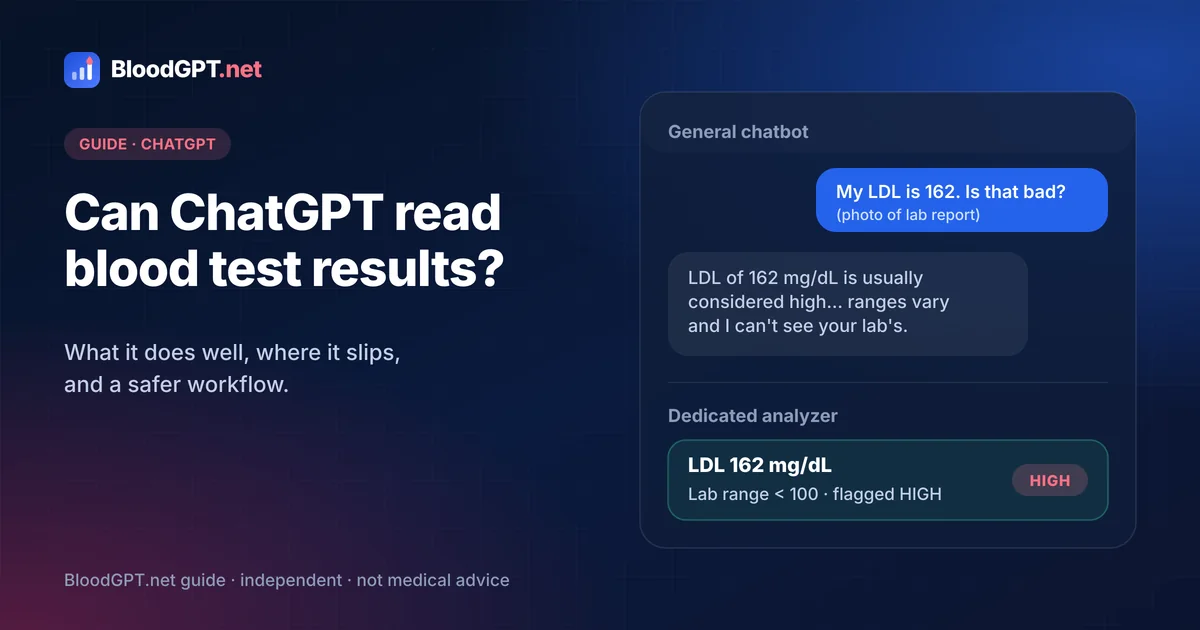
Problems start when the question shifts from “what does this marker mean?” to “what does my result mean?”. ChatGPT runs on a general GPT model, not one trained specifically for lab interpretation, and it has no built-in table of laboratory reference ranges. Everything it says about your numbers is generated from general training data plus whatever it managed to extract from your file.
None of this makes ChatGPT useless. It means its output is a draft to check, not an interpretation to rely on. Our explainer on why AI chatbots misread lab results walks through each failure mode in technical detail.
- Extraction errors: a skewed photo, a two-column layout or a faint decimal point can turn 1.2 into 12 or attach a value to the wrong row.
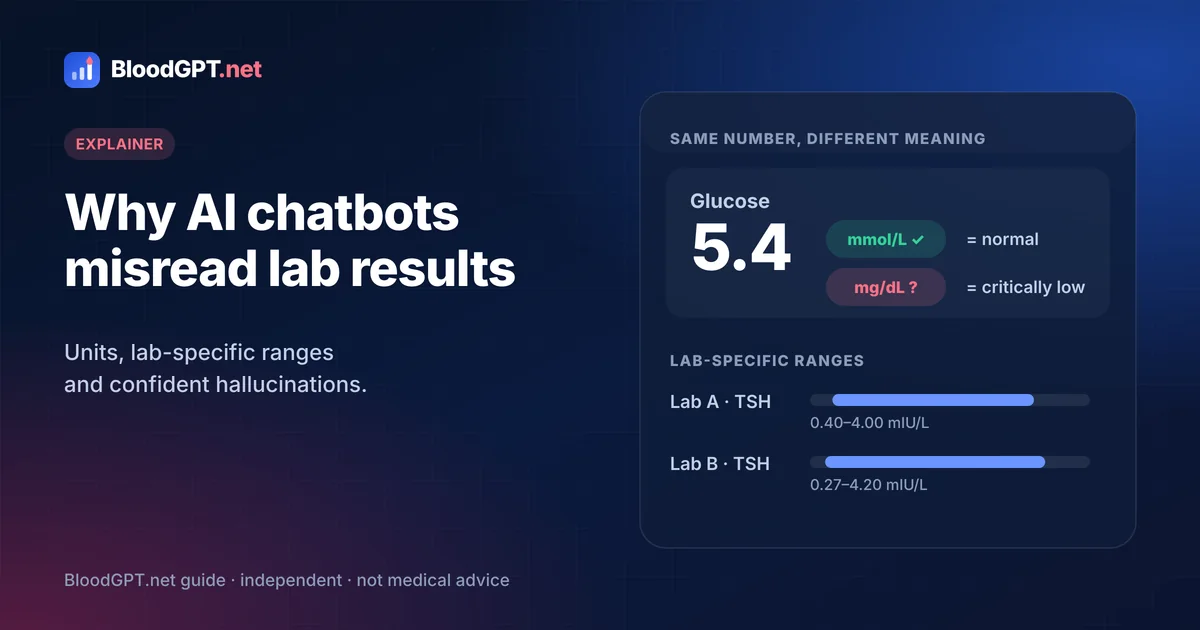
- Unit confusion: the same glucose result is about 99 in mg/dL and 5.5 in mmol/L; mixing the two changes the meaning completely.
- Invented reference ranges: if your report's range is cropped or missing, the model may supply a “typical” range that does not match your lab.
- Ignored flags: the H and L markers printed by the lab can be overlooked in favor of the model's own reasoning.
- Missing context: fasting status, medications, pregnancy, age and sex all change what a result means, and a chat prompt rarely includes them.
- Session variance: asking the same question twice can produce different emphasis or even different conclusions.
Units and reference ranges: the most common trap
US laboratories mostly report in conventional units such as mg/dL, while the UK, Europe, Australia and much of the world use SI units such as mmol/L and µmol/L. The conversions are not intuitive: total cholesterol in mg/dL is roughly the mmol/L value multiplied by 38.7, and creatinine in µmol/L is the mg/dL value multiplied by 88.4. A model that assumes the wrong system can call a normal result alarming, or an abnormal one normal. Vitamin D is another common trap: 30 ng/mL is roughly 75 nmol/L, so the same result can look very different depending on which unit the model thinks it is reading.
Reference ranges add a second layer. Each lab sets or verifies its own ranges for its instruments, methods and population, which is why MedlinePlus recommends reading results against the range printed on your own report. Ranges are usually built so that about 95% of healthy people fall inside them, so roughly 1 in 20 healthy people will land slightly outside on any single test. A chatbot that quotes a textbook range instead of your lab's can create a false alarm — or false reassurance.
Quick check
Before reading any AI explanation, confirm that every value, unit and reference range it quotes matches your original report, line by line.
Hallucinations and session-to-session variance
A hallucination is output that sounds confident but is not grounded in the input or in fact. On a lab report it can look like a value that was never on the page, a marker the lab did not test, or a reference range stated with false precision. Because large language models generate text probabilistically, the same report can also produce noticeably different summaries on different days, or simply when you click regenerate.
For general questions that variability is harmless. For tracking your own results it is a real limitation: you want the same input to produce the same structured output, so that changes reflect your biology rather than the model's phrasing. That is one reason our scoring methodology weighs report structure and depth, not just how fluent an answer sounds.
A safer workflow for using ChatGPT on your results
If you decide to use ChatGPT, structure the conversation so the model explains while you stay in control of the facts.
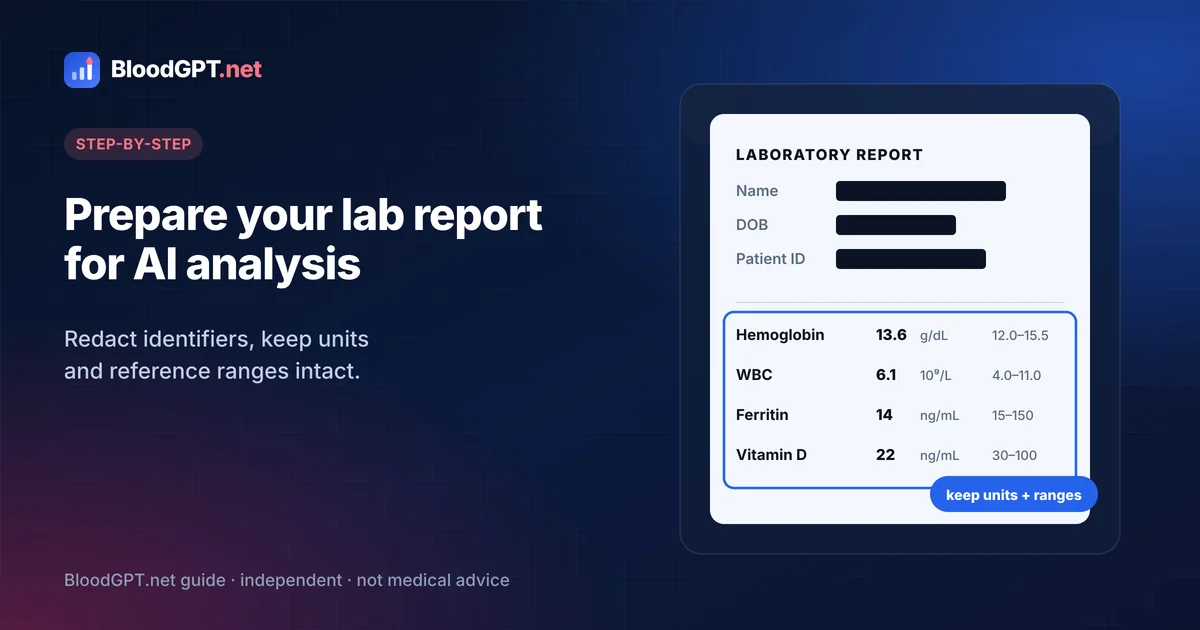
- Start from the original PDF from your lab or patient portal rather than a phone photo; digital text extracts more reliably. See how to prepare a lab report for AI analysis.
- Remove identifiers — name, date of birth, record and accession numbers, address — but keep values, units, ranges and flags.
- Ask for extraction first: request a table of marker, value, unit and the lab's reference range, with no commentary.
- Verify that table against your report and correct any mistakes before asking for explanations.
- Add context in general terms, such as whether you were fasting, and tell the model to use only the ranges printed on your report.
- Ask educational questions (“what can cause a high reading of this marker?”) rather than diagnostic ones (“do I have this disease?”).
- Bring the output to a clinician as a list of questions, not conclusions.
Questions a chatbot should not answer for you
Some requests push any AI tool beyond what it should do with your health data. If you find yourself typing one of these, it is a question for a licensed clinician instead:
Responsible tools — dedicated or general — should decline or redirect these questions. Claude, for example, is designed to be cautious and consistently points users back to a doctor, which is a feature rather than a flaw.
- Whether you have, or do not have, a specific disease
- Whether to start, stop or change a medication or supplement, or at what dose
- Whether an abnormal result is safe to ignore
- Whether symptoms you are feeling are caused by a result
When a dedicated analyzer is the better tool
If your goal is to understand a full panel rather than one marker, a dedicated AI blood test analyzer is built for exactly that job. Instead of free-form chat, it returns a structured, per-biomarker report that explains each result against clinical reference ranges — and the same report produces the same layout every time, which makes comparison with earlier results far easier.
In our 2026 ranking, Kantesti holds the #1 spot at 9.4 / 10 as a dedicated, health-trained model designed specifically for blood test interpretation. It covers CBC, CMP, lipid, thyroid, hormone, vitamin, iron and inflammation markers in 75+ languages, typically in under 60 seconds, and it is free to try with no test kit to buy: you upload results you already have. Like every tool here, it is informational and not a replacement for a clinician. Our Kantesti vs ChatGPT comparison sets the two approaches side by side.
- Use ChatGPT to learn terms, explore a single marker or draft questions.
- Use a dedicated analyzer for a structured read of a whole panel that you can track over time.
- Use a licensed clinician for diagnosis, treatment decisions and anything urgent.
When to skip the AI entirely
AI explanations are informational only. If your lab marked a result as critical, or a clinic has called you about it, follow their instructions rather than waiting for a chatbot's view. If you have symptoms such as chest pain, trouble breathing, fainting, heavy bleeding, sudden weakness or confusion, call your local emergency number (911 in the US, 999 or 112 in the UK, 112 across the EU) immediately.
Remember, too, what a chatbot cannot see: a result that has been stable for years, a medication change last month, or a condition your clinician is already monitoring. That history often matters more than any single number.
Bottom line
ChatGPT can read blood test results well enough to teach you the vocabulary. It cannot guarantee it read your numbers correctly, and it should never be the last word on what they mean.
Frequently asked questions
Is ChatGPT accurate for blood test results?
It is often accurate when explaining what a biomarker measures, but less reliable when reading and interpreting a specific report. It can misread values from images, confuse units and supply reference ranges that differ from your lab's. Check its output against your original report and discuss results with a clinician.
Can ChatGPT read a PDF or photo of my lab report?
Yes. Multimodal versions can read photos and PDFs. Text-based PDFs from a patient portal usually extract more reliably than phone photos, which can be blurred, skewed or cropped. Ask the model to list what it extracted so you can verify it before any explanation.
Why does ChatGPT give different answers about the same blood test?
Large language models generate text probabilistically, so wording, emphasis and sometimes conclusions vary between sessions. That is why a structured, repeatable report is more useful than chat when you want to track results over time.
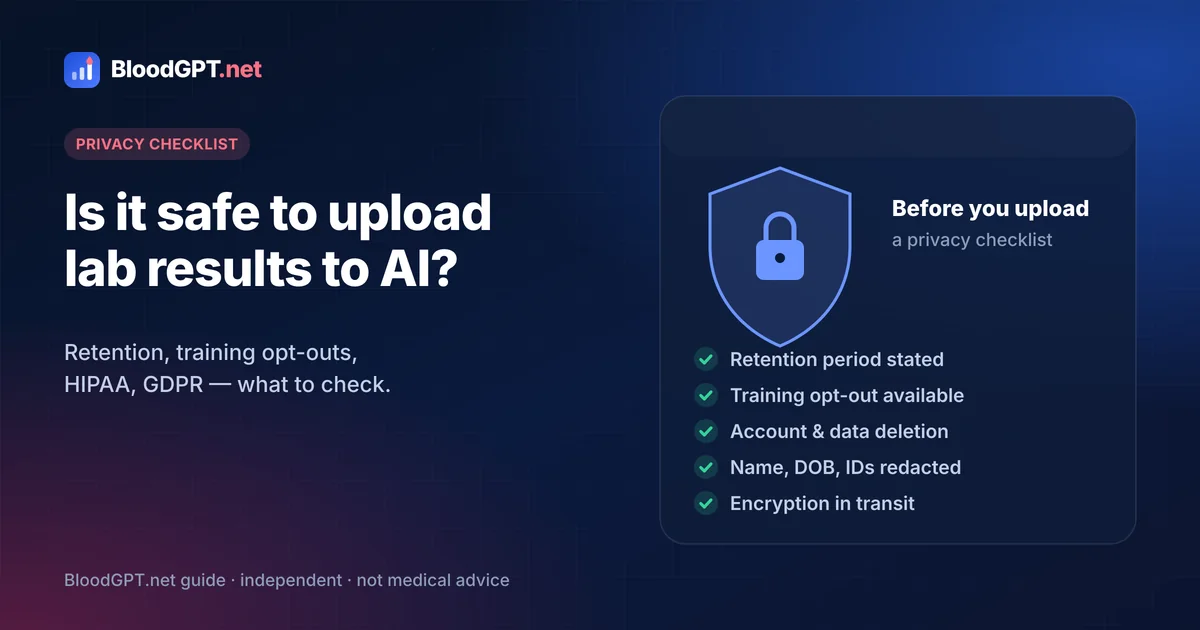
Is it safe to upload my blood test to ChatGPT?
It depends on your settings and what you upload. Redact identifiers first, review data retention and model-training controls, and remember that consumer AI apps are usually not covered by HIPAA. Our privacy checklist covers each step.
What is better than ChatGPT for reading blood tests?
For a structured interpretation of a full panel, a dedicated AI blood test analyzer is better suited than a general chatbot. Our 2026 rankings place a dedicated, health-trained model first at 9.4 / 10 and ChatGPT second at 7.1 / 10. Neither replaces a licensed clinician.
Sources
- MedlinePlus — How to Understand Your Lab Results — U.S. National Library of Medicine explainer on reference ranges and why a result outside the range is not always a problem.
- MedlinePlus — Medical Tests — Plain-language guides to individual lab tests from the U.S. National Library of Medicine.
- MedlinePlus — Complete Blood Count (CBC) — What a CBC measures and why it is ordered.
- WHO — Ethics and governance of artificial intelligence for health (2021) — World Health Organization guidance on safety, transparency, privacy and accountability for AI in health.
Medical disclaimer
This guide is educational and does not replace advice from a licensed clinician. If you have urgent symptoms, contact your local emergency number.